

The internet is shifting. Not just in how we use it, but in who is using it on our behalf. We are entering a phase where agents powered by large language models are not just tools. They are participants. They reason, plan, take actions, and increasingly mediate how humans interact with the digital world.
This change isn’t coming from the big AI platforms like OpenAI, Anthropic, or Google. Those are closed ecosystems where agent logic is hidden and monetization is locked down. What’s emerging is an ecosystem of agents built in open frameworks by independent developers, researchers, and startups. These agents don’t live in walled gardens. They are flexible, composable, and operate across devices, browsers, and environments with visible reasoning flows and custom behaviors.
But there’s a problem. There is no economic layer for these agents. No way to fund their development at scale. No standard method for monetization. And no way for advertisers to participate in this new space responsibly.
That’s why we built AgentVine.
AgentVine is the first ad network designed specifically for agentic software. We make it possible for developers to offer products and services within agent decision flows. Not on screens. Not in banners. In logic. The way agents actually think.
Why Now
Agents are becoming the interface layer between users and the web. When someone uses an onboarding assistant, a travel planner, or a hiring advisor, they aren’t looking at a list of links. They are asking the agent to interpret their goals and act. The agent might search, compare, or even decide which product or tool to use.
In this context, advertising can’t be a pop-up or a search result. It has to be a behavior. Something the agent can evaluate, reason through, and potentially act on. AgentVine provides a structured way for that to happen.
Structured Suggestions, Not Static Ads
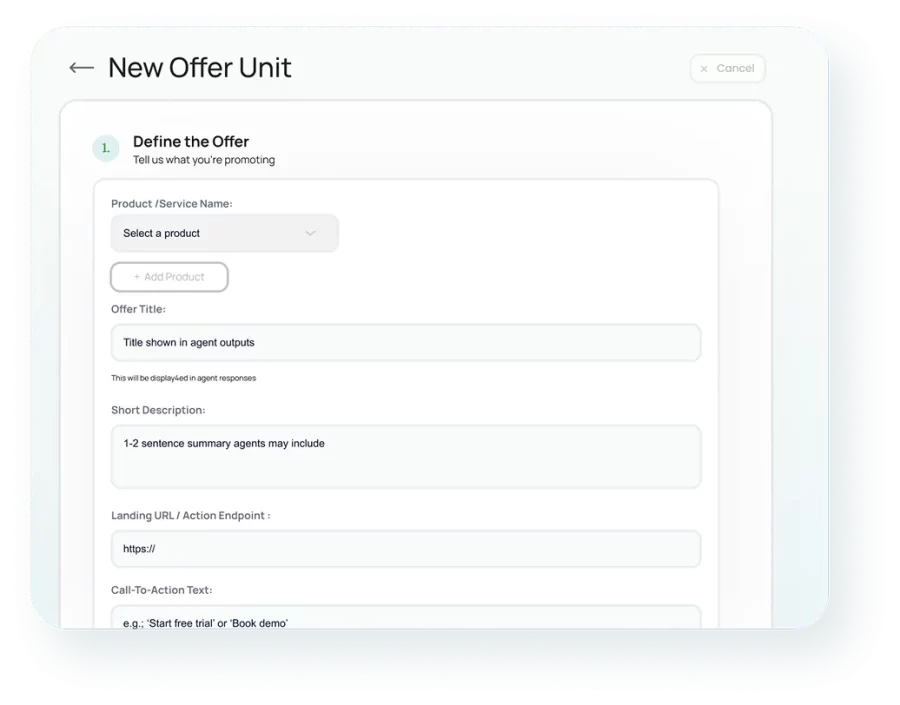
At the core of AgentVine is something we call an Offer Unit. This is a structured, intent-matched ad payload. It contains the product offer, target intent, suggested phrasing, payout model, and metadata that helps the agent reason about it.
Offer Units are not hidden in prompts or bolted onto UI. They are exposed to the agent’s logic layer, where decisions happen. The agent can consider whether an offer is relevant, how to phrase it, and whether it aligns with the user’s goal.
If it fits, the offer appears as a natural suggestion. If it doesn’t, it doesn’t.
Who It Serves
AgentVine is a two-sided platform.
Advertisers use it to define when and how their product should be considered. Instead of bidding on keywords, they define Offer Units targeted to specific intents. These could include planning a wedding, managing remote teams, or comparing productivity tools. Each unit includes a bid, action URL, phrasing options, and payout terms.
Developers opt in using our SDK. They choose when, how, and if offers are allowed inside their agents. The SDK gives them full control over phrasing, categories, placement, and filtering. They get paid when the user acts on a sponsored suggestion.
And users? They interact with agents that remain helpful, trustworthy, and unobtrusive. Offers only appear if they are relevant and clearly marked.
Trust, Control, and Alignment
Everything in AgentVine is built to respect agent autonomy and user trust.
We don’t inject prompt-level tricks. We don’t track users. We don’t smuggle content into completions. Offers are always structured, auditable, and context-aware. Developers stay in control. Users stay informed.
This isn’t a gimmick to insert ads into AI. It’s a model for how monetization can work in a reasoning-first world.
Where This Goes
AgentVine is launching in a moment when the internet is opening back up. After years of closed ecosystems, the agent economy is being driven by open protocols, open frameworks, and developers building on their own terms.
We believe those developers deserve infrastructure that helps them succeed. We believe advertisers deserve tools that let them participate without eroding trust. And we believe users deserve agents that are honest about what they recommend.
AgentVine is not about replacing humans. It’s about supporting the way humans are starting to use software. If agents are going to suggest tools, products, or services, we think there should be a fair, open, and structured way for that to happen.
Not as a trick. Not as a hack. As a decision.
That’s what we’re building.